Cash Out Explained: How It Works, What It Costs and When It Makes Sense
What is cash out in betting? How the offer is calculated, why it is usually below fair value, partial and automatic cash out, and a simple rule for when to take it.
· 9 min readCash out looks like the perfect safety net: your bet is going well, so you take the money now, or it is going badly and you limit the loss. In reality it is a separate product with its own price, and that price includes a margin for the operator.
This guide explains what cash out is, how the offer is calculated, the difference between full, partial and automatic cash out, and a simple rule for deciding whether to take an offer or let the bet run.
What cash out means
Cash out lets you close a bet before the event is over and receive an amount decided by the operator. The amount depends on how your bet looks at that moment: if your selections are ahead or the odds have moved in your favour, the offer rises, and if they are behind, it falls. Once you accept, the bet is settled and you can no longer win or lose more on it.
How the cash out offer is calculated
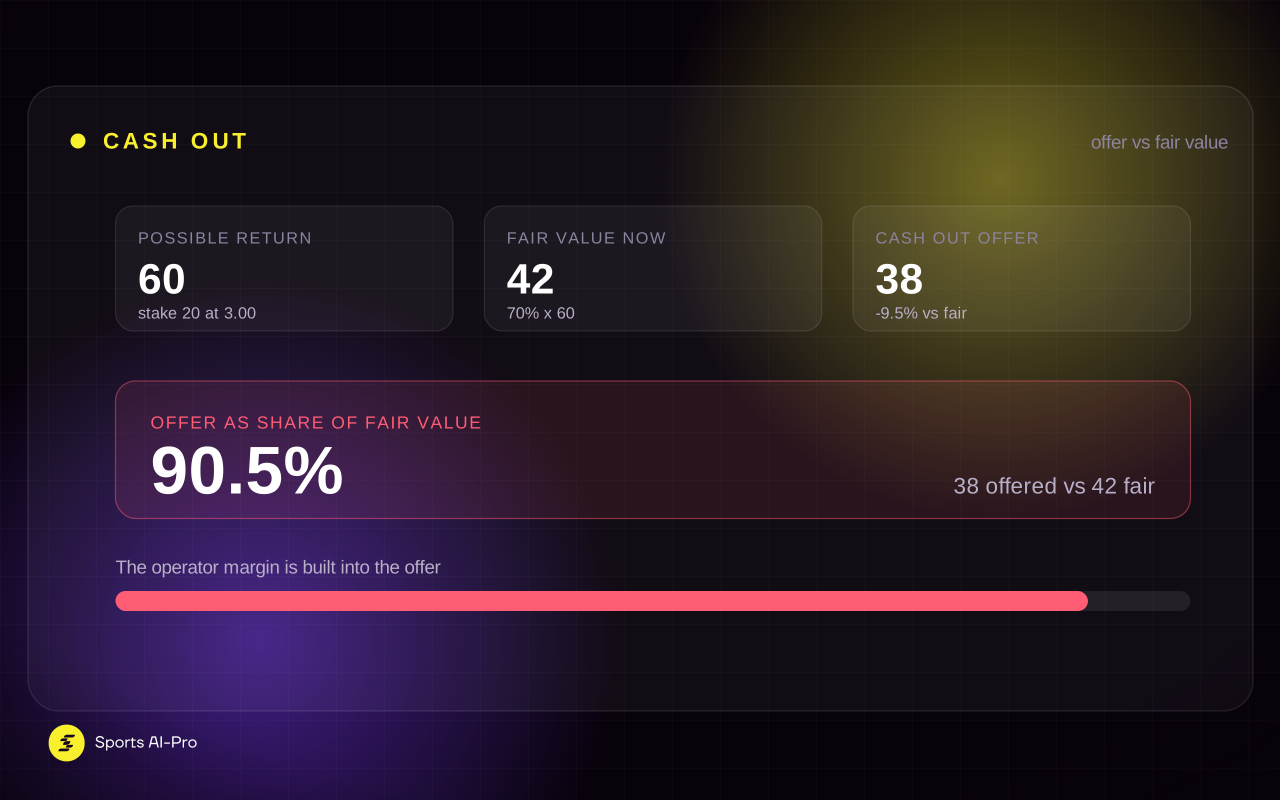
Operators price cash out from the current chance that your bet wins and the return it would pay, then subtract a margin. A simple way to see it: fair value is the possible return multiplied by the probability that the bet wins now, and the offer you see is usually lower than that. The example below uses made-up numbers.
| Step | Example |
|---|---|
| Stake | 20 |
| Odds | 3.00 |
| Possible return | 60 |
| Chance the bet wins now | 70% |
| Fair value (return x chance) | 42 |
| Cash out offer | 38 |
| Gap to fair value | -4 (-9.5%) |
Three kinds of cash out
When cash out can make sense
These are situations where taking an offer is a reasonable decision rather than a habit:
- The situation has changed in a way the price has not caught up with yet, for example a key injury after you bet
- You want to lock in a profit on an accumulator with one leg still to play, and the offer is close to fair value
- Your stake is a large share of your bankroll, and variance would hurt more than the margin costs
- You need the money back before the event ends
When cash out costs you
Cash out has a margin every time you use it. If you cash out often, those margins add up like a small tax on every bet.
- Taking small profits early on bets that were priced well turns a long-term edge into a smaller one
- An offer far below fair value is common on accumulators with several legs still to play
- Offers can be suspended at key moments, so you cannot count on cashing out when you want to
A simple rule: compare the offer with your own probability
Hold or cash out is a probability question. Estimate the chance that your bet wins now, multiply it by the possible return and compare the result with the offer. If your estimate is lower than the one built into the offer, cashing out is better, and if it is higher, holding is better. The table uses the same bet as above.
| Your estimate | Holding is worth | Cash out offer | Better choice |
|---|---|---|---|
| 55% | 33 | 38 | Cash out |
| 70% | 42 | 38 | Hold |
The result depends entirely on how good your estimate is, which is why a model-based probability beats a gut feeling. Holding is only better on average: any single bet can still lose.
Cash out and your bankroll
Cash out is a tool for managing risk, not a way to turn losing bets into winners. Decide your stakes and limits before you bet, and treat a cash out as a rare exception to the plan, not a reflex.
Common mistakes with cash out
- Cashing out every winning bet early and letting losing bets run
- Ignoring that the offer already contains the operator's margin
- Treating cash out as a guarantee when it can be unavailable or suspended
- Cashing out in a hurry without comparing the offer with your own probability
Data-driven sports predictions
AI-assisted match analysis - team stats, H2H, a bet builder and predictions generated by artificial intelligence.
Bet responsibly. Predictions are analytical estimates, not certainties.
The offer is a price
Cash out is priced by the operator and usually sits below fair value.
Compare, do not react
Weigh the offer against your own probability and the possible return.
Frequent cash outs cost you
Each one carries a margin that adds up over time.
Use it as an exception
Plan stakes in advance and cash out rarely, for good reasons.
What is cash out in betting?
Cash out lets you settle a bet before the event ends for an amount the operator offers. The amount depends on how your bet is doing at that moment, and after you accept, the bet is closed.
Is cash out worth it?
Sometimes. It can help you lock in a profit or limit a loss when circumstances change, but the offer includes a margin, so using it often costs money over time.
Why is my cash out offer lower than my potential winnings?
The offer is based on the chance that your bet still wins, not on the full return, and the operator subtracts a margin. A bet with a 70% chance to win a possible return of 60 is worth about 42 before the margin.
What is partial cash out?
Partial cash out lets you take part of the offer now while the rest of your stake stays on the original bet. Availability depends on the operator and the market.
Why is cash out not available on my bet?
Operators may switch cash out off for certain markets, at key moments such as a penalty or a goal check, or when the odds are changing fast. Terms differ between operators, so check the rules.
Bet smarter with Sports AI-Pro
Team stats, H2H and the analysis panel are free. Unlock AI predictions with a subscription.