xG in Football (Soccer): What Is Expected Goals and How to Use It
What is xG (expected goals) in football? See how xG is calculated, how to read xG for/against and form, and how to use it to analyse and bet on matches.
· 8 min readA 0-1 scoreline can lie. A team can lose a match in which it created five clear chances while the opponent scored from its only dangerous moment. That is exactly what xG (expected goals) describes - it measures the quality of the chances created, not whether the ball happened to go in.
This guide explains what xG is in football (soccer), how it is calculated, what xG for/against says about a team's form, and how to use it when betting without falling into the common traps.
What xG is in football (soccer)
xG (expected goals) is a number from 0 to 1 assigned to each shot, describing the probability it ends in a goal. A shot worth 0.3 xG means that similar chances are scored roughly one time in three. Add up the xG of every shot in a match and you get a team's expected number of goals.
xG does not tell you what happened (the score does that) - it tells you how good the performance was at creating and conceding chances. Two teams can both win 1-0, but the one with 2.4 xG played very differently from the one with 0.5, and xG predicts the next matches better than the result.
How xG is calculated
An xG model rates each shot on features that historically affect the chance of a goal: distance and angle to goal, body part, type of play (open play, set piece, counter), defenders in the way and the assist. The table below shows how those factors translate into xG.
| Shot factor | Effect on xG |
|---|---|
| Penalty | ≈ 0.79 xG - very high |
| Close-range shot (six-yard box) | High xG |
| One-on-one chance | High xG |
| Header from a cross | Usually low xG |
| Shot from outside the box | Low xG (≈ 0.03–0.05) |
| Tight angle / long distance | The worse the angle and longer the distance, the lower the xG |
Different models give slightly different values because they use different data and weights. That is normal - xG is an estimate, not an absolute measurement. Stick to one consistent source and compare teams on the same scale.
xG for and against: reading form
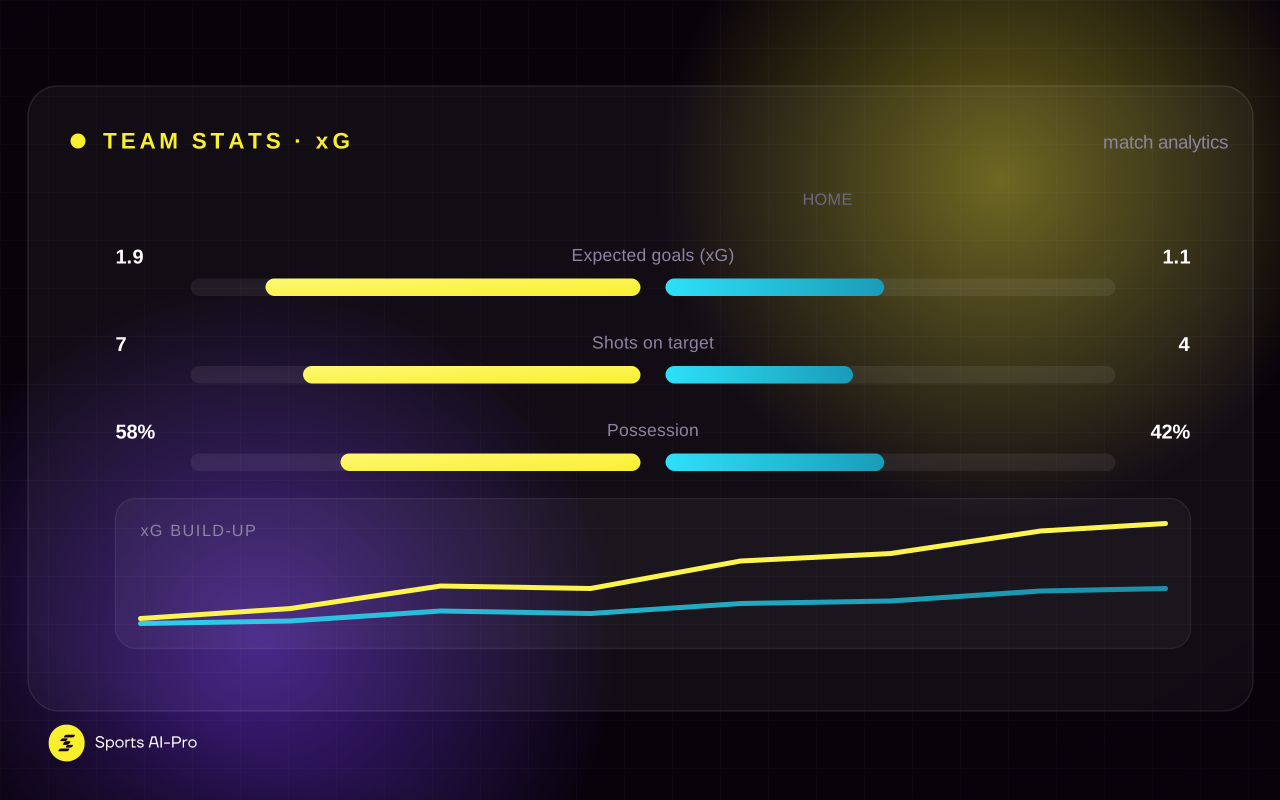
xG is most valuable over time. xG for (created) shows attacking strength, xG against (conceded) shows defensive exposure. Results jump around from match to match due to luck and finishing, but xG forms a steadier picture. Below, xG is clearly calmer than goals alone.
If a team has had higher xG than actual goals for several rounds, it is probably underrated and results should soon improve (regression to the mean). The reverse - a winning run on low xG - is a warning sign: the points may soon dry up.
xG vs the result: why xG can matter more
Consider a match where the home side loses 0-1 with 2.1 xG to 0.6. The score says “defeat,” but the performance says “domination without finishing.” In the next game the home side is the favourite despite the fresh loss, because xG describes the real level better.
This is exactly why analysts and AI models base predictions on xG rather than results alone: a single result is noisy, while xG filters out some of that noise and shows repeatable performance quality.
Data-driven football predictions
AI-assisted match analysis - team stats, H2H, a bet builder and predictions generated by artificial intelligence.
Bet responsibly. Predictions are analytical estimates, not certainties.
How to use xG when betting
xG on its own is not a tip - it is a signal you must combine with context and the odds. The most common uses:
| Use case | What xG gives you |
|---|---|
| Assessing form | Separates real performance from lucky results |
| Over/Under markets | Both teams' xG shows a match's scoring potential |
| 1X2 picks | The xG for/against gap suggests the real favourite |
| Spotting regression | Results above xG usually revert to the mean |
| Judging defence | Low xG against = a solid backline |
Always combine xG with context: lineups, injuries, how much the match matters, the opponent's style. xG tells you how a team plays on average, but a specific game can look different if a key striker is missing or the tactical approach changes.
The limits of xG
xG does not see everything. It ignores a specific player's finishing quality (some are better or worse than average), pressure, fatigue and game state - a team that leads often cedes the pitch and posts lower xG even while controlling the match. Small samples (2–3 games) can also mislead.
So xG is one pillar of analysis, not an oracle. It works best combined with other data (form, H2H, home/away) and always over a larger number of matches, where the noise averages out.
How to read xG wisely
Look at trends, not a single match. Compare xG for and against with actual goals to spot teams that are “too good” or “too poor” relative to results. Use the same xG source and the same scale so comparisons make sense.
Treat xG as a lens that sharpens the picture of play, not a guarantee. Combined with the odds (and value thinking) it helps you catch teams the market prices on results rather than on real quality.
xG measures quality, not the result
It is the sum of goal probabilities across every shot in a match.
The long run wins
xG for/against is steadier than goals and predicts better.
Look for regression
Results far from xG usually revert to the mean.
xG is a signal, not a tip
Combine it with context and the odds, especially for value.
What does xG mean in football?
xG (expected goals) is a number from 0 to 1 describing the probability a given shot ends in a goal. The sum of xG in a match is a team's expected number of goals - a measure of chance quality, independent of whether the ball actually went in.
Is xG reliable?
As an estimate, yes - especially over many matches, where it averages out the noise in results. In a single game it can mislead, because it ignores finishing quality, game state and pressure. Read it as a trend and from one consistent source.
How is xG different from goals scored?
Goals say what happened; xG says how good the performance was at creating chances. A team can win 1-0 on low xG (luckily) or lose on high xG (without finishing). That is why xG predicts future results better than the scores themselves.
Bet smarter with Sports AI-Pro
Team stats, H2H and the analysis panel are free. Unlock AI predictions with a subscription.

