How to Bet on Football: Beginner's Betting Guide
How to bet on football step by step: how to read betting odds, markets, the bookmaker's margin and bankroll rules. A practical beginner's guide.
· 8 min readBetting on football is not a lottery or a hunch - it is decision-making under uncertainty. Before you place your first slip, it pays to understand what odds really mean, what the markets are, and where the bookmaker gets its edge. This guide walks you through the basics step by step.
You will learn to read odds as probability, recognise the most popular markets, understand the bookmaker's margin, and manage your budget so you can play longer and smarter instead of losing it all at the start.
How odds work
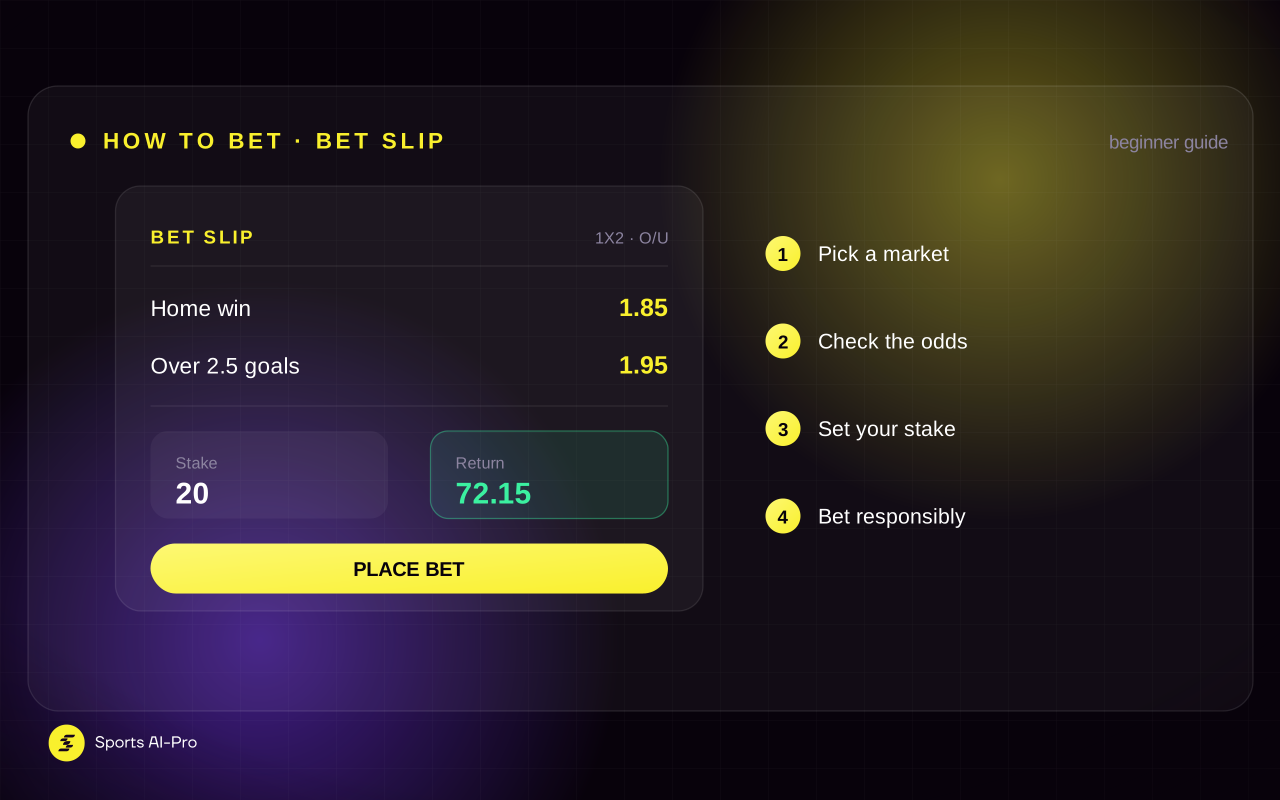
Odds are the price of a bet and, at the same time, the probability baked into it. Decimal odds of 2.00 mean that if you stake and win, you get twice your stake back (stake × odds). Higher odds mean a lower chance in the bookmaker's view and a bigger potential win; lower odds mean a higher chance and a smaller payout.
In Europe, decimal odds (e.g. 1.85, 2.40) are the standard. Your payout is simply stake × odds, and profit is payout minus stake. Before you bet, always check how much you can really win and lose - that is the first step to staying in control.
How to read betting odds (and the margin)
To judge whether odds are favourable, turn them into probability: 1 ÷ odds. Odds of 2.00 are 50%, 1.50 is about 66.7%. That is the “implied” probability - how likely the market thinks the event is. Comparing it with your own estimate is how you start thinking like a sharp bettor, not a fan.
The table below is a quick cheat sheet for turning odds into probability. Memorising a few points lets you judge in a second whether a bet is even worth a closer look.
| Odds | Implied probability |
|---|---|
| 1.50 | 66.7% |
| 2.00 | 50.0% |
| 2.50 | 40.0% |
| 3.00 | 33.3% |
| 4.00 | 25.0% |
The most popular markets
When starting out, stick to simple, liquid markets before moving to exotic ones. These are where most bettors begin:
| Market | What it means |
|---|---|
| 1X2 (match result) | Home win (1), draw (X) or away win (2) |
| Over/Under (goals) | Above or below a line, e.g. 2.5 goals in the match |
| BTTS (both teams score) | Whether both teams score at least one goal |
| Handicap | A virtual head start to level a mismatch before kickoff |
| Correct score | An exact result - high odds, low chance |
You do not need to know every market at once. Master one (e.g. 1X2 or Over/Under), understand what drives it, and only then widen your range. Less is more while you are learning.
The bookmaker's margin: why the total exceeds 100%
If you convert all the 1X2 odds of the same match into percentages and add them up, you get more than 100%. That surplus is the margin (overround) - the bookmaker's built-in edge. The example below shows the odds “with margin” next to fair chances.
That is why simply calling results right is not enough to profit - you must find odds higher than the true probability to beat that margin. It is the foundation every effective strategy is built on.
Data-driven football predictions
AI-assisted match analysis - team stats, H2H, a bet builder and predictions generated by artificial intelligence.
Bet responsibly. Predictions are analytical estimates, not certainties.
Where to start - step by step
A good start is not a “genius tip” but a repeatable process and budget control. Stick to a few simple rules:
- Set a bankroll - an amount you can lose without affecting your life; never bet money meant for bills.
- Start with one market (e.g. 1X2) before trying harder ones.
- Stake small, consistent amounts - usually 1–2% of your bankroll per slip.
- Turn odds into probability and compare with your own estimate before betting.
- Log every bet and its result - learn from data, not emotion.
The key is surviving variance. Even good decisions produce losing runs, so small, consistent stakes let you keep playing and actually learn instead of quickly zeroing your account.
Common beginner mistakes
The first mistake is betting with your heart - on your team or a favourite “because it has to win.” The second is chasing losses: raising stakes after a defeat to win it back, which usually ends in an even bigger loss. The third is staking too much relative to your budget.
The fourth is ignoring the margin and the odds - betting without checking whether the price is even favourable. The fifth is keeping no records: without a log you cannot tell luck from skill, and you repeat the same mistakes.
Bet responsibly
Betting should be entertainment, not a way to earn a living or pay off debt. Set time and money limits in advance, take breaks, and never bet under the influence of emotion, alcohol or the urge to win back losses.
If you feel you are losing control, use responsible-gambling tools (deposit limits, self-exclusion) and seek support. A smart bettor knows when to walk away - that is part of the skill, not a weakness.
Odds are probability and price
Turn odds into a % (1 ÷ odds) before you bet.
Start with simple markets
Master 1X2 or Over/Under before moving on.
The margin is always there
The 1X2 sum is > 100% - you must beat it to profit.
Bankroll above all
Small, steady stakes let you survive and learn.
How do I start betting on football?
Set a budget you can afford to lose, pick one simple market (e.g. 1X2), learn to turn odds into probability, and stake small, consistent amounts. Keep records and expand your knowledge only once you understand the basics.
Can you actually win at betting?
Long-term profit is very hard because you must beat the bookmaker's margin by finding odds higher than the true probability (value). That takes discipline, data and patience. Most bettors lose - so treat betting as entertainment with a set budget.
How much money should I start with?
Only what you can lose without affecting daily life. A common rule is to stake 1–2% of your bankroll per bet, so you survive the inevitable losing runs and can keep playing.
Bet smarter with Sports AI-Pro
Team stats, H2H and the analysis panel are free. Unlock AI predictions with a subscription.

