Sports Betting Tips: How to Pick Matches With a Method, Not a Hunch
Sports betting tips that hold up: a 7-step process from match analysis through odds and value to a tip journal, plus the most common mistakes.
· 8 min readPeople who search for sports betting tips usually want one of two things: ready-made tips for the weekend, or a method for finding better tips themselves. This guide gives you the method. It also shows how to check ready-made tips from tipsters, forums or AI models before you trust them with money. One thing up front: no tip guarantees a win, and anyone who promises one is a warning sign.
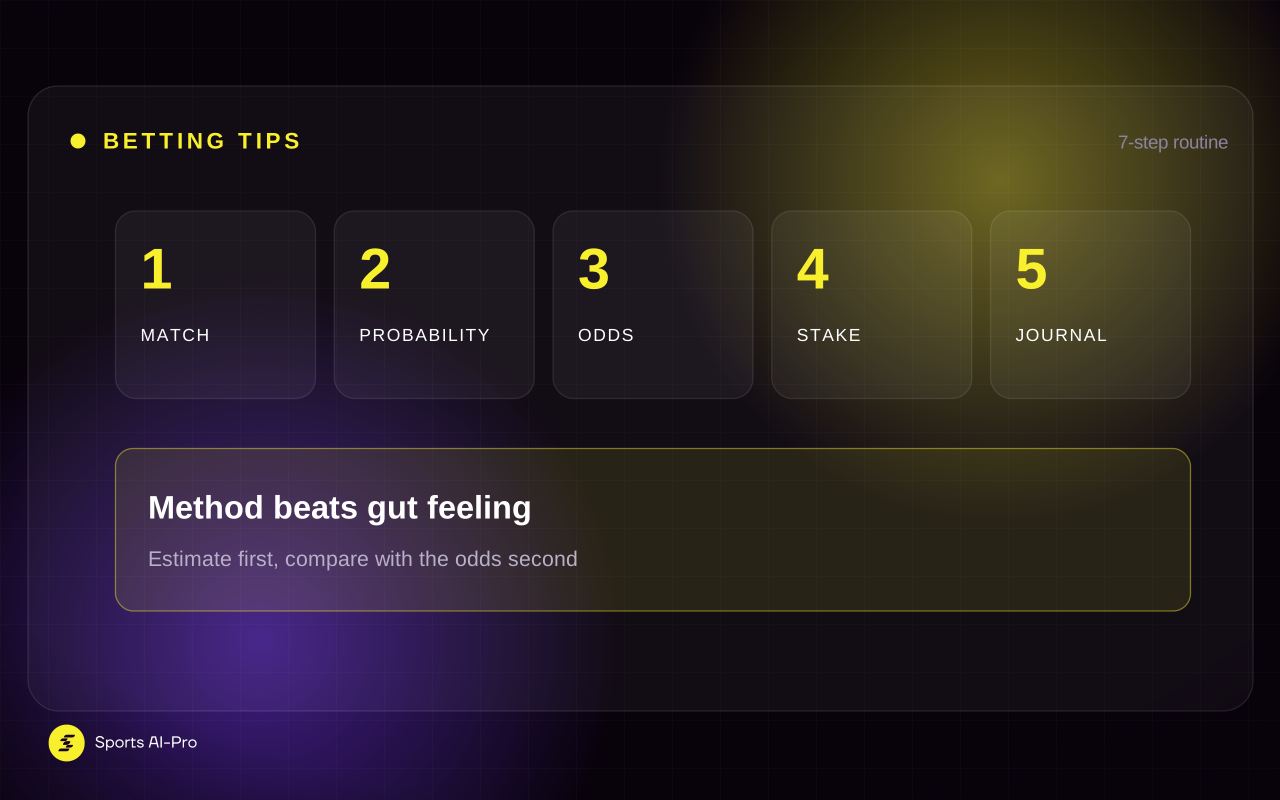
The most common thinking error is the question "Who will win?". The odds already contain a lot of knowledge, so a good tip is not the most likely outcome but an outcome whose price is fair or too generous. "Who will win?" becomes "Is this price better than it should be?". That takes a fixed routine, not a gut feeling.
Step 1: Pick few matches and one market
The fewer matches you rate, the better you know them. Focus on one or two leagues you follow regularly and on a manageable market: match result (1X2), double chance, over/under goals or both teams to score. If you tip twenty matches from ten leagues every week, you end up tipping on feel.
Step 2: Analyse form, strength and context
Good match analysis answers a few clear questions. The table below shows what matters and where the limits are.
| Factor | The question behind it | Caution |
|---|---|---|
| Recent form | How did the last games look, and against whom? | Five games are a small, noisy sample |
| Home and away | How do performance and results differ at home and away? | Home advantage varies from league to league |
| Chance quality (xG) | Were the results deserved or lucky? | xG is an estimate, not a result |
| Table and motivation | Is it about relegation, the title, a cup or nothing at all? | Motivation is hard to measure |
| Absences and line-up | Are key players missing, is the XI known? | Line-ups often arrive shortly before kick-off |
| Schedule and workload | European games, travel or a short break? | Rotation is hard to predict |
| Head-to-head (H2H) | Is there a recurring pattern? | Old meetings say little once squads and coaches have changed |
Step 3: Estimate the probability before you see the odds
Write down how likely you think each outcome is before you look at the odds, otherwise you unconsciously anchor on the price. The three values must add up to 100 percent, for example home win 48 percent, draw 27 percent, away win 25 percent. Writing it down forces you to be honest and lets you check your accuracy later.
Step 4: Compare with the odds
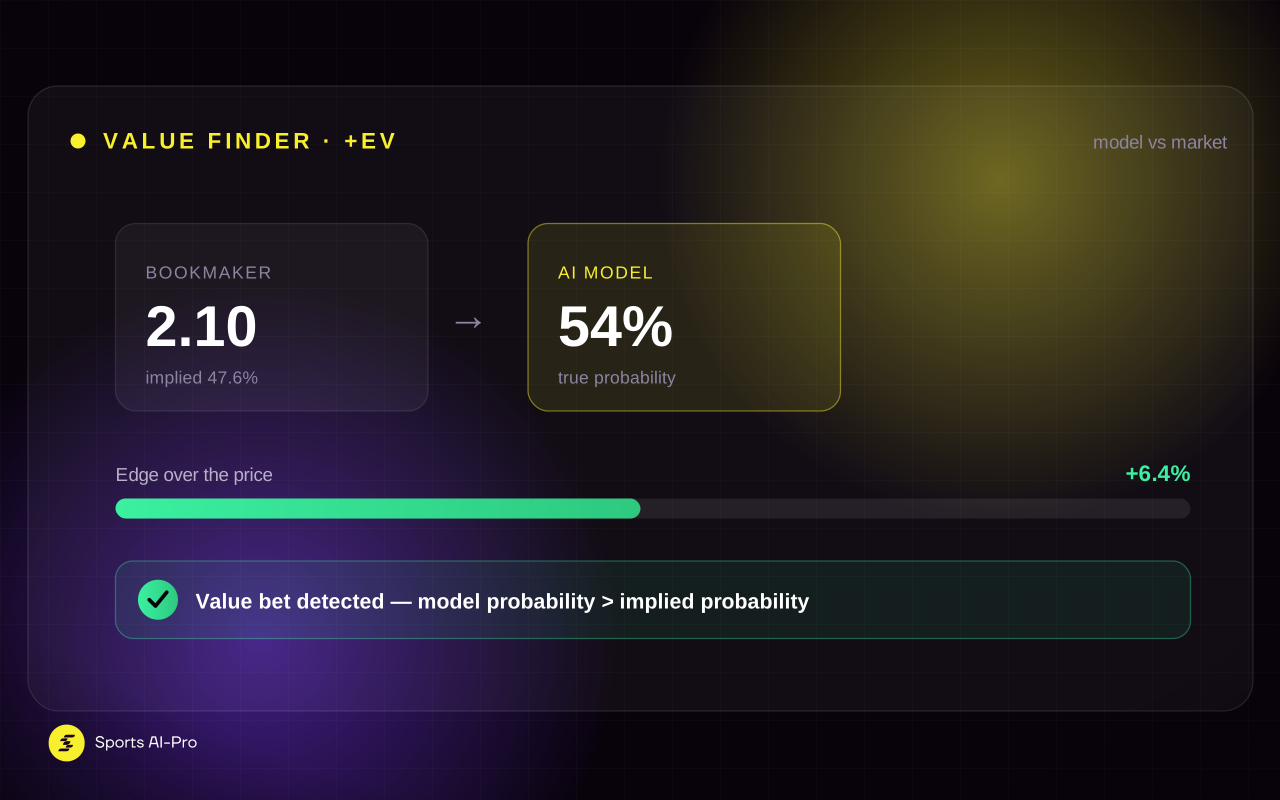
Convert the odds to an implied probability: 1 divided by the odds. If your estimate is clearly higher, there may be a value bet. The worked example below uses made-up numbers to show the routine only.
| Outcome | Your estimate | Odds | Implied (1 / odds) | Result |
|---|---|---|---|---|
| Home win | 48% | 2.30 | 43.5% | Possible value, +4.5 percentage points |
| Draw | 27% | 3.40 | 29.4% | No value |
| Away win | 25% | 3.10 | 32.3% | No value |
The implied values add up to 105.2 percent. The 5.2 percent above 100 is the bookmaker's margin, the built-in price of the bet. The higher the margin, the bigger your edge must be. You can find more in our guide to value betting.
Step 5: Set the stake in advance
Decide the stake before you place the tip, not afterwards. A common rule of thumb is one to two percent of your betting budget per tip, less when you are unsure. That way your budget survives a losing run, which every tipping record contains. For staking methods, see our guide to betting strategy and bankroll management.
Step 6: Record every tip
A tip journal is the most effective tool against self-deception. Note every tip with these details:
- Date, match and market
- Your estimated probability and the odds
- Stake and result
- One line of reasoning, so you can see later what you missed
The review only becomes meaningful after a few dozen tips, better after more than a hundred. Before that, chance shapes the picture.
Step 7: Judge by probability, not by hit rate
A lost tip at 70 percent was not automatically wrong, and a won tip at 20 percent was not automatically smart. Check instead whether your estimates are right on average: did your 60 percent tips land about six times out of ten? Also compare your odds with the closing odds. If you regularly get better prices than the market offers at kick-off, that is a good sign.
The most common mistakes in betting tips
- Tipping your favourite club, where emotion replaces analysis
- Long accumulators: every extra leg multiplies the margin too
- Chasing losses: higher stakes after a bad result
- Too many matches and markets, so none is checked properly
- Judging tips without looking at the odds
- In-play bets made on emotion instead of a plan
- Following other people's tips blindly without knowing the source or method
Judging ready-made tips: tipsters, forums and AI
You do not have to work out every tip yourself, but check ready-made tips with the same questions: Is a probability given, or just a pick? Can earlier tips be verified with odds and stake? Are the assumptions explained? Does the provider promise "100 percent sure tips"? Then be suspicious.
| Source | Strength | Weakness |
|---|---|---|
| Your own analysis | You know the assumptions and limits | Takes time, prone to gut feeling |
| Tipsters | Saves research | Often no verifiable record, wins shown selectively |
| Forums and social media | Many perspectives | Hype, survivorship bias |
| AI models | Calculate consistently, give probabilities | Only as good as data and calibration, guarantee nothing |
AI forecasts work well as a research layer: they give you a probability that you test against the odds. In Sports AI-Pro, for example, you see the model's confidence in percent for every match, next to team statistics, standings and head-to-head. The decision stays with you.
Data-driven football predictions
AI-assisted match analysis - team stats, H2H, a bet builder and predictions generated by artificial intelligence.
Bet responsibly. Predictions are analytical estimates, not certainties.
Bet responsibly
Only bet with money you can afford to lose, and set firm limits for stake and time. Betting is for adults only (the legal age depends on where you live) and the rules differ by country, so check that the provider is licensed where you are. If
Method beats gut feeling
Pick few matches, estimate the probability yourself and only then compare it with the odds.
The odds include a margin
Take 1 divided by the odds and add up the outcomes: everything above 100 percent is the bookmaker's price.
A journal exposes mistakes
After about a hundred tips a journal shows whether your estimates are right.
Check ready-made tips
Ask for probabilities and a verifiable record, and distrust guarantees of wins.
What are the best sports betting tips for beginners?
Few matches, one manageable market, small fixed stakes and a tip journal. Beginners gain more from discipline than from a secret system.
Can you win for sure with sports betting tips?
No. Even well-reasoned tips lose regularly because chance plays a big role in football and other sports. An edge, if there is one, only shows over many bets.
How many tips should I place per week?
As many as you can analyse thoroughly. Three to five tips a week is often enough to start. More tips do not mean more profit, usually just less care.
Are free sports betting tips reliable?
That depends on the source, not the price. Check whether probabilities are given, whether earlier tips can be verified and whether the provider says openly that nothing is guaranteed.
How do I analyse a football match for a bet?
Check form, home and away record, chance quality, absences, schedule and what the match means for each side. Then estimate the probability of each outcome and compare it with the odds.
Bet smarter with Sports AI-Pro
Team stats, H2H and the analysis panel are free. Unlock AI predictions with a subscription.