Betting Odds Explained: Odds Converter and Implied Probability
Betting odds explained: how decimal, fractional and American odds convert, how to calculate implied probability and remove the bookmaker margin.
· 8 min readOdds are a price and a probability at the same time. Once you can switch between decimal, fractional and American formats and turn any of them into an implied probability, bookmaker prices stop being mysterious and become something you can test against your own estimate.
This guide covers how each odds format works, how to convert between them, how to calculate implied probability and why the bookmaker margin makes the percentages add up to more than 100%.
What odds really tell you
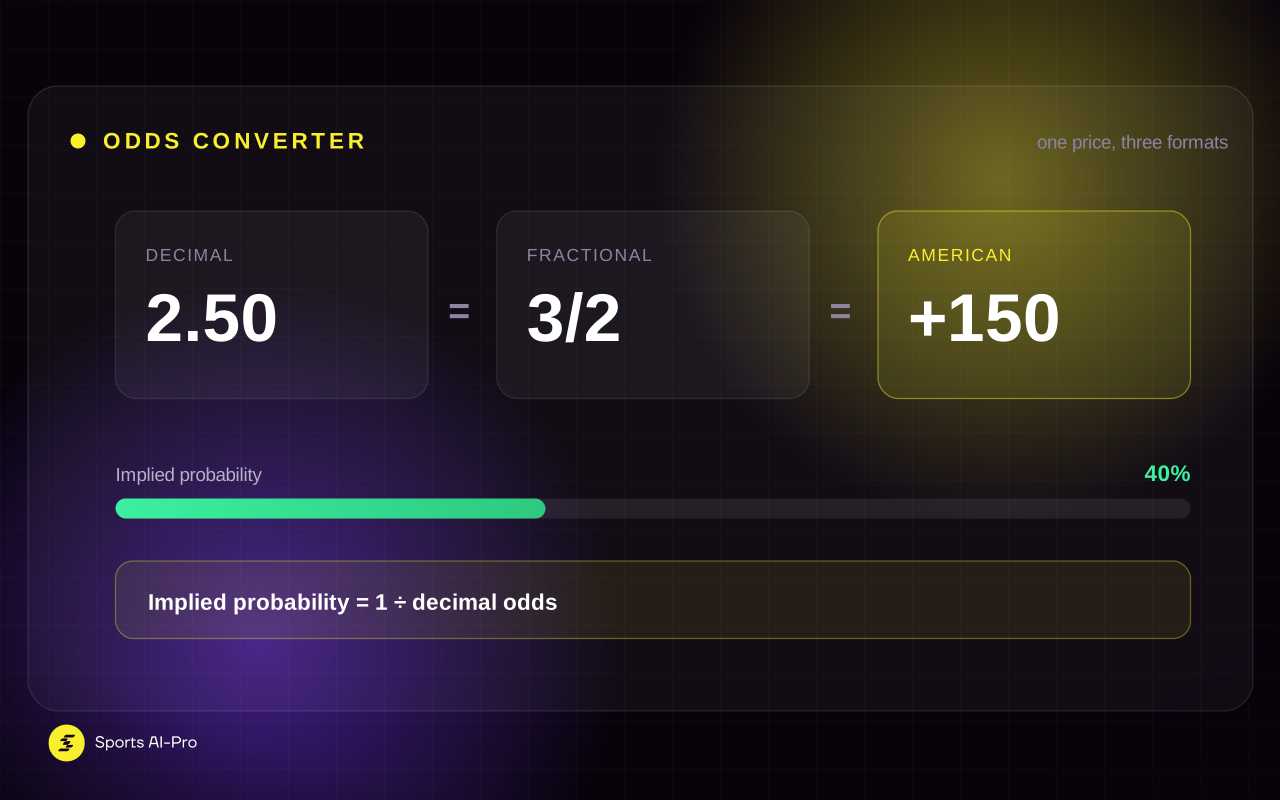
Decimal odds show the total return per unit staked, stake included. At 2.50, a stake of 10 returns 25 if you win. The same number also encodes a probability: implied probability = 1 ÷ decimal odds, so 2.50 implies 40%.
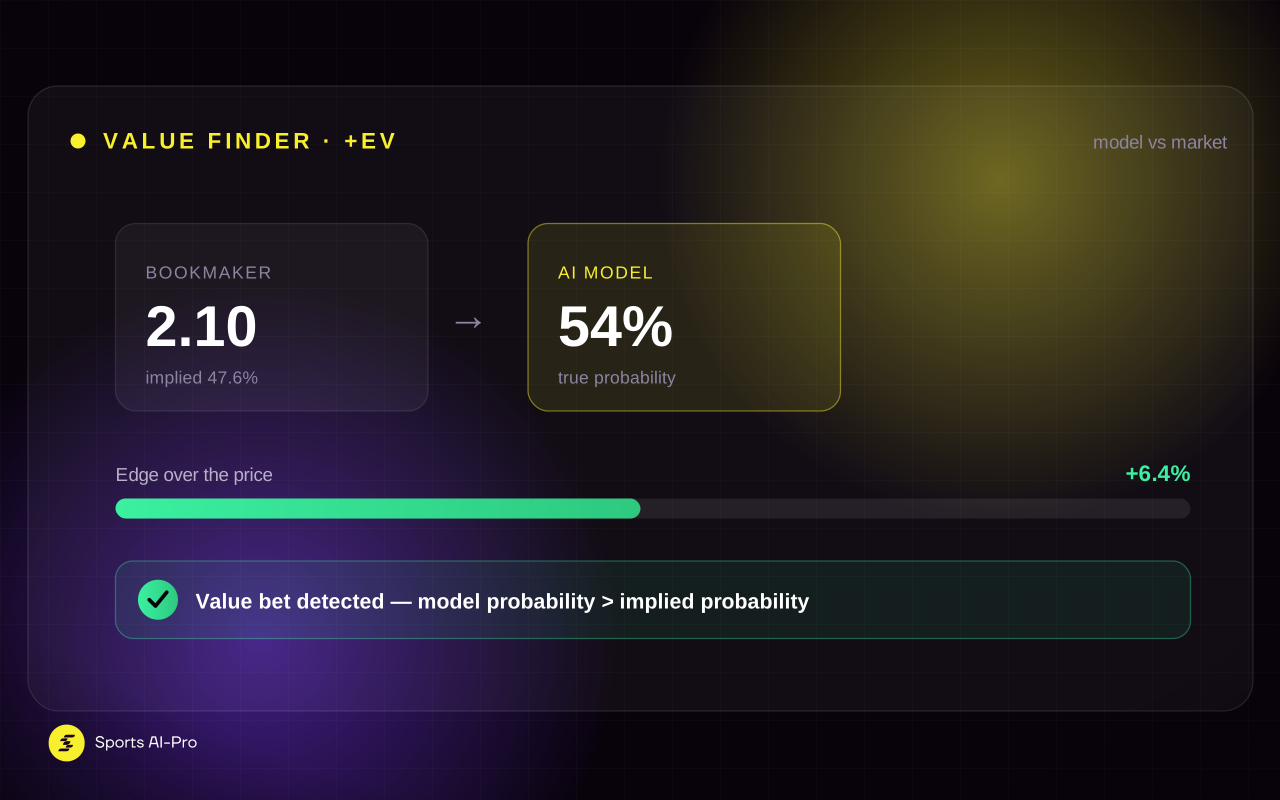
That probability is the bookmaker’s price, not the truth. If you believe the real chance is higher than 40%, the bet has value; if lower, it does not. Everything else in this guide is a way to make that comparison faster.
Decimal, fractional and American odds
The same price can be written three ways. Decimal odds are standard in Europe, fractional odds are traditional in the UK and Ireland, and American (moneyline) odds are used in the US. The table shows common prices in all three formats with their implied probability.
| Decimal | Fractional | American | Implied probability |
|---|---|---|---|
| 1.50 | 1/2 | -200 | 66.7% |
| 2.00 | 1/1 | +100 | 50.0% |
| 2.50 | 3/2 | +150 | 40.0% |
| 3.00 | 2/1 | +200 | 33.3% |
| 4.00 | 3/1 | +300 | 25.0% |
To convert: decimal to fractional is decimal minus 1 written as a fraction (2.50 → 1.50 = 3/2). Fractional to decimal is the fraction plus 1. For American odds, a positive number is the profit on a stake of 100 (+150 → 2.50) and a negative number is the stake needed to win 100 (-200 → 1.50).
Formulas: positive American odds → decimal = odds ÷ 100 + 1; negative American odds → decimal = 100 ÷ odds (ignoring the minus) + 1. An odds converter does this instantly, but knowing the formula helps you spot a misread price.
Implied probability and the bookmaker margin
Add up the implied probabilities of every outcome in a market and you get more than 100%. The surplus is the bookmaker’s margin. Example for a football match: home 2.10, draw 3.40, away 3.60.
| Outcome | Odds | Implied probability | Fair probability | Fair odds |
|---|---|---|---|---|
| Home | 2.10 | 47.6% | 45.4% | 2.20 |
| Draw | 3.40 | 29.4% | 28.1% | 3.56 |
| Away | 3.60 | 27.8% | 26.5% | 3.77 |
| Total | - | 104.8% | 100.0% | - |
To remove the margin, divide each implied probability by the total (104.8%). That gives fair probabilities that sum to 100% - a better benchmark for judging value than the raw prices.
Raw vs fair probability
The margin inflates every outcome a little. The chart shows the implied probability from the raw odds next to the fair probability after the margin is removed.
A value bet needs your own probability to beat the raw implied probability, not the fair one - the margin is the hurdle you must clear.
Data-driven football predictions
AI-assisted match analysis - team stats, H2H, a bet builder and predictions generated by artificial intelligence.
Bet responsibly. Predictions are analytical estimates, not certainties.
How to use odds in practice
Turn every price you look at into a number you can compare:
- Convert the odds to decimal if they are not already.
- Calculate the implied probability: 1 ÷ odds.
- Remove the margin to get the market’s fair probability.
- Compare it with your own estimate from stats, xG or a model.
- Bet only when your probability clearly beats the raw implied probability.
Memorise a few anchors (1.50 ≈ 66.7%, 2.00 = 50%, 4.00 = 25%) to judge prices at a glance before you calculate.
Common mistakes with odds
The first mistake is confusing formats: reading 3/2 as 3.00 instead of 2.50, or +150 as 1.50. The second is ignoring the margin and treating implied probabilities as true chances. The third is comparing probabilities with odds from different bookmakers without checking which price you can actually get.
Also watch for rounding: use at least two decimals, and never assume that a short price such as 1.20 means a sure thing - it only means a high implied probability.
Odds are a probability in disguise
Implied probability = 1 ÷ decimal odds.
Formats are just notation
Decimal, fractional and American odds describe the same price.
The margin inflates the total
Implied probabilities add to more than 100%; remove it to find fair odds.
Compare with your own estimate
A bet has value only if your probability beats the implied one.
How do you calculate implied probability from odds?
Divide 1 by the decimal odds. For 2.50 that is 1 ÷ 2.50 = 40%. For fractional odds convert to decimal first; for American odds use the formulas above.
How do you convert American odds to decimal?
For positive odds divide by 100 and add 1 (+150 → 2.50). For negative odds divide 100 by the odds without the minus sign and add 1 (-200 → 1.50).
How do you convert fractional odds to decimal?
Divide the numerator by the denominator and add 1. So 3/2 becomes 1.50 + 1 = 2.50, and 1/2 becomes 0.50 + 1 = 1.50.
Bet smarter with Sports AI-Pro
Team stats, H2H and the analysis panel are free. Unlock AI predictions with a subscription.