BTTS and Over/Under Goals: How to Bet on Both Teams to Score
Both teams to score (BTTS) and over/under 2.5 goals explained: how to estimate probability, fair odds, what drives goals and how to find value.
· 8 min readBoth teams to score (BTTS) and over/under goals are the most popular football markets after 1X2. They ignore who wins and ask a simpler question: how many goals will there be, and will both sides find the net? That makes them ideal for analysis based on xG and form.
This guide explains how BTTS and over/under 2.5 work, how to turn expected goals into probabilities and fair odds, what really drives goals and the mistakes that cost bettors money.
What BTTS and over/under mean
BTTS (both teams to score, also called goal/no goal) wins on “Yes” if each team scores at least once, whatever the final result: 1-1 and 3-2 both count, 3-0 does not. Over/under bets on the total goals in the match against a line, most often 2.5: over wins with three or more goals, under with two or fewer.
The two markets overlap but are not the same. A 3-0 win is over 2.5 and BTTS No; a 1-1 draw is under 2.5 and BTTS Yes. Treating them as one bet is the first mistake to avoid.
From expected goals to fair odds
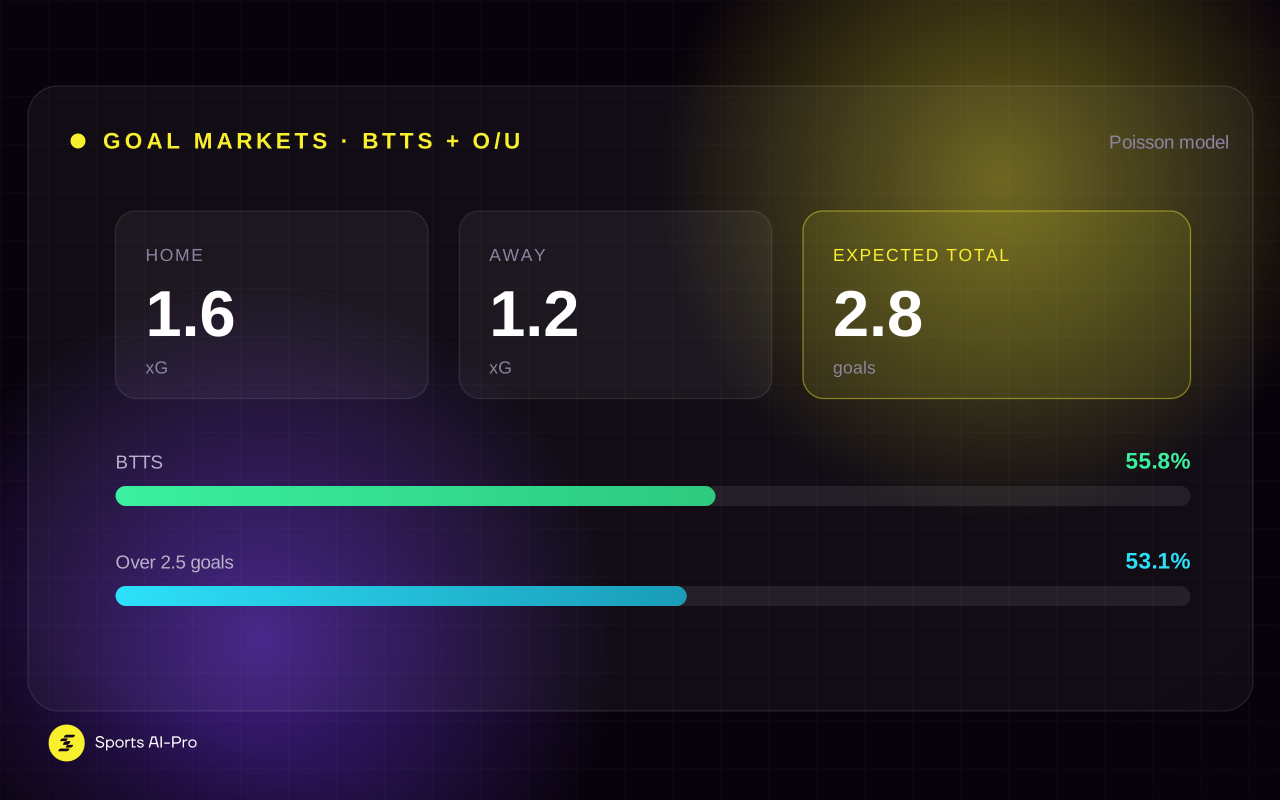
A simple way to price both markets is the Poisson model. Say a match is expected to produce 1.6 goals for the home side and 1.2 for the away side (from xG, form and team news), so 2.8 in total. The model turns those averages into probabilities, and the probabilities into fair odds (1 ÷ probability).
| Market | Probability | Fair odds | Bookmaker odds |
|---|---|---|---|
| BTTS Yes | 55.8% | 1.79 | 1.85 |
| BTTS No | 44.2% | 2.26 | 2.10 |
| Over 2.5 | 53.1% | 1.88 | 1.80 |
| Under 2.5 | 46.9% | 2.13 | 2.00 |
Compare the fair odds with what the bookmaker offers. Here only BTTS Yes beats its fair price (1.85 against 1.79), worth about +3.2% expected value. The other three prices are at or below fair odds, so there is nothing to bet. This is value betting applied to goal markets.
What really drives goals
The average is only the starting point. Before betting, adjust it for the factors that change how many goals a particular match produces:
| Factor | Effect on goals |
|---|---|
| Attack and defence quality | xG for and against over the last 8-10 games beat raw goals scored. |
| Team news | A missing striker or first-choice goalkeeper moves both BTTS and totals. |
| Style and tempo | High press and open play raise goals; low blocks and slow build-up lower them. |
| Stakes | Relegation fights and cup ties often make teams cautious; dead rubbers open up. |
| Weather and pitch | Heavy rain, wind or a poor pitch tend to reduce quality and goals. |
Treat the model as a baseline and the factors as adjustments. If team news removes a top scorer, trim the home expected goals before you compare with the bookmaker.
BTTS vs over 2.5: not the same bet
In open, attacking leagues both markets hit more often, but they do not move together all the time. Matches with one dominant side often go over without both teams scoring, while cagey matches can end 1-1 and stay under (illustrative figures).
That gap is why you should price each market separately and avoid stacking them in one accumulator: the outcomes are correlated, so the bookmaker’s combined price is not the product of two independent chances.
Data-driven football predictions
AI-assisted match analysis - team stats, H2H, a bet builder and predictions generated by artificial intelligence.
Bet responsibly. Predictions are analytical estimates, not certainties.
How to analyse BTTS and totals
A repeatable routine keeps the analysis honest:
- Collect xG for and against for both teams, split into home and away.
- Estimate the expected goals for each side and add team news adjustments.
- Turn the averages into probabilities with a Poisson calculator or model.
- Compare the fair odds with the bookmaker’s price and look for a clear edge.
- Log the bet with your probability so you can check calibration later.
Skip matches where your estimate is within a couple of percent of the market. A small edge is easily wiped out by an error in the inputs.
Common BTTS and over/under mistakes
The first mistake is betting BTTS Yes just because both teams usually score: it ignores the price. The second is using goals scored instead of xG, which rewards lucky finishing. The third is overlooking motivation and lineups on the day.
Others: stacking correlated goal markets in accumulators, chasing over 2.5 after a high-scoring weekend, and ignoring that the 2.5 line and the 2.25 or 2.75 lines are priced differently.
Two different markets
BTTS needs both teams to score; over/under counts total goals.
Probability beats gut feeling
Turn expected goals into probabilities and compare fair odds with the price.
Team news changes the numbers
Missing strikers, goalkeepers and tactics shift both markets.
Do not stack correlated bets
BTTS and over often overlap, so combining them counts the same idea twice.
What does BTTS mean in betting?
BTTS stands for both teams to score. A BTTS Yes bet wins if each team scores at least one goal, regardless of who wins or the final scoreline.
What does over 2.5 goals mean?
It wins if the match has three or more goals in total. Two goals or fewer means under 2.5 wins.
Which is better: BTTS or over/under?
Neither is better by itself. Pick the market where your estimated probability is higher than the one implied by the odds, and price each market separately.
Bet smarter with Sports AI-Pro
Team stats, H2H and the analysis panel are free. Unlock AI predictions with a subscription.