How to Bet on Tennis: Markets, Surfaces, Form and Value
How to bet on tennis: main markets, how surface and form change the odds, the serve and return stats that matter, a two-way odds example and a five-step routine.
· 9 min readTennis looks simple to bet on: two players, one winner. In practice prices move with every point, the surface changes who is favoured and small edges are easy to lose to the margin. A method matters more than a hunch.
This guide covers the main tennis betting markets, how surface, form and schedule affect a match, the serve and return numbers worth checking, how to turn odds into a probability, and a five-step routine you can repeat for every bet.
Why tennis is different from football betting
Tennis has no draw, so most markets are two-way and the margin is smaller than in a three-way football market. A match is built from points, games and sets, so a single break of serve can change the price at once. Individual players matter more than teams, which makes form, fitness and surface easier to read but also more volatile.
The main tennis betting markets
Most bets fall into a handful of markets. Pick the one where you can actually form an opinion.
| Market | What you bet on | Good to know |
|---|---|---|
| Match winner | Which player wins the match | The simplest market and usually the tightest price |
| Set betting | The exact set score, such as 2-1 | Higher odds and more variance |
| Total games | Whether the number of games is over or under a line | Depends on how close the players are and on the serve |
| Game handicap | A player wins with a head start or a deficit in games | Useful when you expect a lopsided match |
| First set winner | Who wins the opening set | Fast starts and slow starters matter here |
| Live betting | Bets placed while the match is being played | Prices move after every game, so act on a plan |
Surface changes everything
The same two players can be priced very differently on clay, grass and hard courts. Always check how each player has performed on the surface of the match, not only overall.
| Surface | Typical effect | What to check |
|---|---|---|
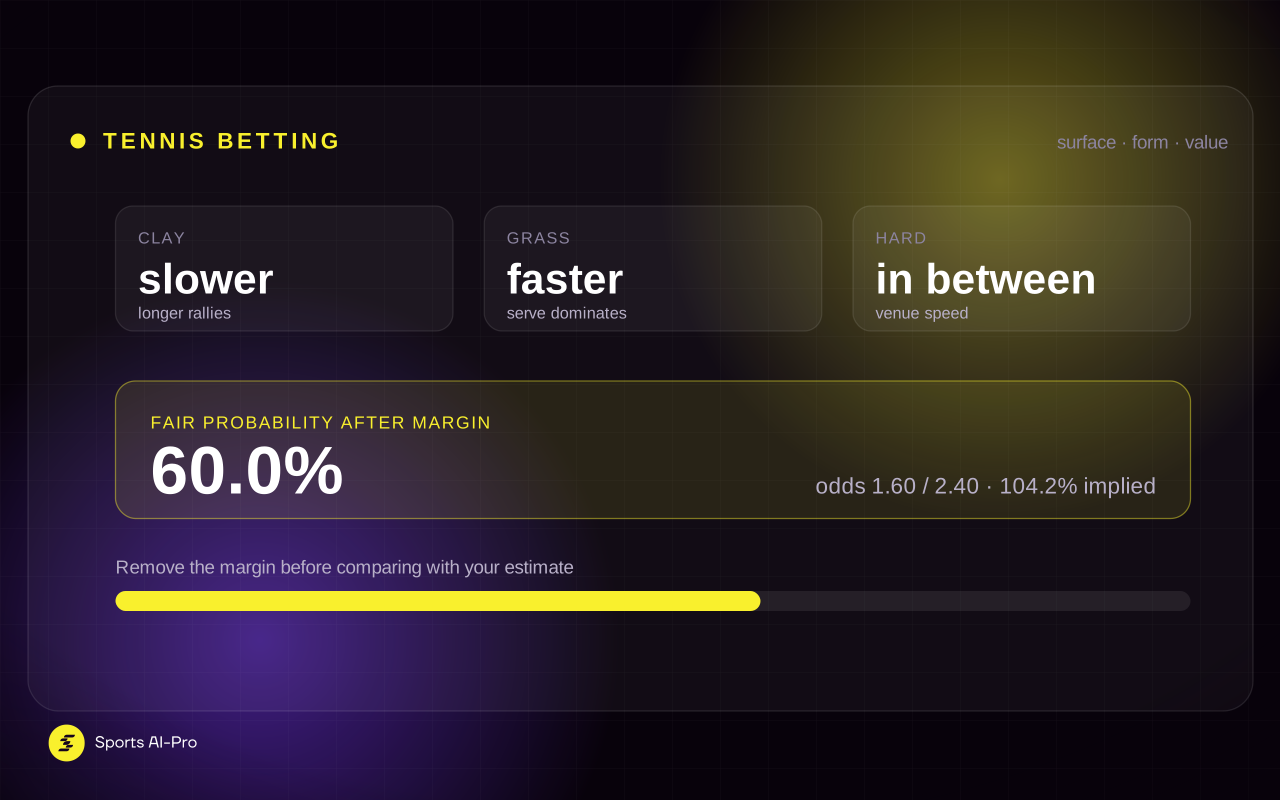
| Clay | A slower court and higher bounce, with longer rallies and more breaks of serve | Results on clay and endurance |
| Grass | Fast and low bounce, so serve dominates and tiebreaks are common | Serve numbers and grass-court record |
| Hard | In between, and speed varies by venue and by indoor or outdoor play | Venue speed and recent hard-court form |
Form, fitness and schedule
Recent results on the same surface tell you more than a ranking. Add these checks before you form an opinion:
- Recent results on the same surface and level
- Fitness and injury news, including how long the last match lasted
- Travel and fatigue from the previous week
- Motivation, since some players treat smaller events as preparation
- Head-to-head record, used with caution, because surface and time change the picture
Serve and return numbers that matter
Serve decides a lot in tennis, so a few statistics are worth reading together:
- First-serve percentage and points won on first and second serve
- Break points saved and converted
- Return points won against similar opponents
Turn tennis odds into a probability
Convert both prices to implied probability, add them up and remove the margin to see what the market really thinks. The table uses made-up odds.
| Player | Decimal odds | Implied probability |
|---|---|---|
| Player A | 1.60 | 62.5% |
| Player B | 2.40 | 41.7% |
| Total of implied probabilities | 104.2% | |
| Probability without the margin | 60.0% / 40.0% |
If your own estimate for player A is 66%, the price of 1.60 implies 62.5%, a gap of 3.5 percentage points in your favour. That gap only matters if your estimate is well founded, and even a real edge loses often.
Live betting and retirements
Prices move after every game in live betting, and the rules for a player who retires or does not start differ between operators. Read them before you bet, especially in smaller tournaments.
- Check what happens to your bet if a player retires or withdraws before or during the match
- Use a plan and a stake size decided before the match, not during it
- Avoid chasing a bet after a break of serve changes the price
A five-step routine for every tennis bet
Data-driven sports predictions
AI-assisted match analysis - team stats, H2H, a bet builder and predictions generated by artificial intelligence.
Bet responsibly. Predictions are analytical estimates, not certainties.
Surface comes first
The same player can be a favourite on one surface and an underdog on another.
Mind the margin
Convert odds to probability and remove the margin before you compare.
Read the retirement rules
They differ between operators and can void or settle a bet.
Stay disciplined
A small fixed stake and a record of your bets beat reacting to every game.
How do you bet on tennis?
Pick a match and a market such as match winner, set betting or total games, check the surface, form and fitness, convert the odds to probability and place a small stake. Most tennis markets are two-way, so there is no draw.
What is the best tennis bet for beginners?
Match winner is the simplest market because there are only two outcomes and no draw. Learn to read the odds and the surface first, then try total games or handicaps.
How many sets are in a tennis match?
Most matches are best of three sets. Men's singles at the four Grand Slams are best of five sets, and women's Grand Slam matches are best of three.
What happens to my bet if a player retires?
Rules differ. If a player withdraws before the match, bets are usually void, while a retirement during the match is treated differently depending on the operator and how much of the match was played. Read the terms before you bet.
Is head-to-head useful in tennis?
Only with context. A record built on a different surface or years ago says little, so weigh recent form on the same surface more heavily.
Does the surface really change the odds?
Yes. A baseline player may be a clear favourite on clay and an underdog on grass, so check surface-specific results before you bet.
Bet smarter with Sports AI-Pro
Team stats, H2H and the analysis panel are free. Unlock AI predictions with a subscription.