Moneyline, Point Spread and Totals Explained (What -110 Means)
Moneyline, point spread and totals explained for NFL and NBA bettors: what -110 means, how American odds convert to probability, and how to compare a line with your own estimate.
· 9 min readAmerican sportsbooks price almost every NFL and NBA game in three ways: who wins (moneyline), by how many points (point spread) and how many points are scored in total (over/under). Prices are written as American odds such as -110 or +150, which look confusing until you see they are just another way to write a probability.
This guide explains each bet type, what -110 means, how to convert American odds into decimal odds and implied probability, and how to compare a line with your own estimate before you bet.
The three main American bet types
Most NFL and NBA betting comes down to three markets. They can be combined into parlays, but each one starts from the same game.
| Bet | What you bet on | Example line |
|---|---|---|
| Moneyline | Which team wins the game, with no margin involved | Home team -180 / away team +150 |
| Point spread | A team wins by more than, or loses by less than, a set margin | Home team -3.5 (-110) |
| Total (over/under) | Whether the combined score is above or below a line | Over 47.5 (-110) |
How to read American odds
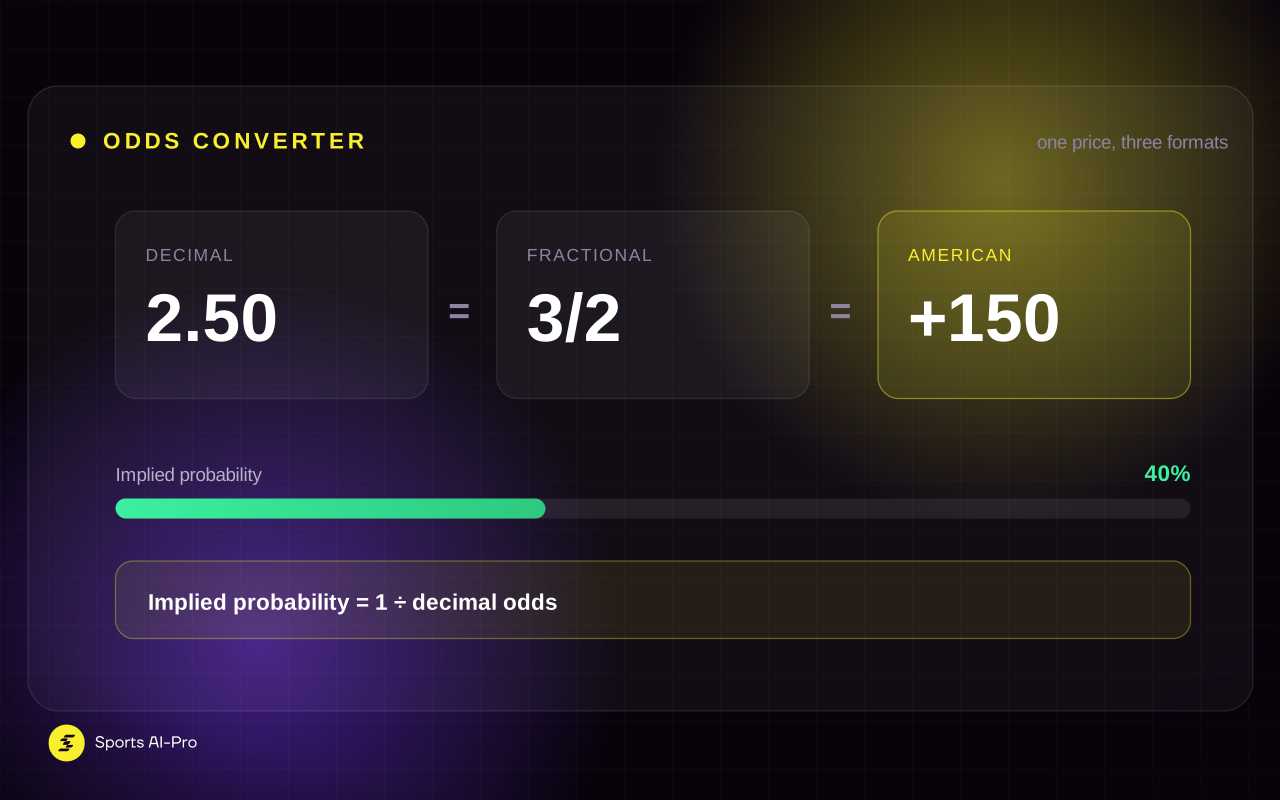
A minus sign shows how much you must stake to win 100, so -200 means staking 200 to win 100. A plus sign shows how much you win on a stake of 100, so +150 means winning 150 on 100. The table converts both to decimal odds and implied probability, which is how you compare them with a model.
| American odds | Meaning | Decimal odds | Implied probability |
|---|---|---|---|
| -110 | Stake 110 to win 100 | 1.91 | 52.4% |
| -200 | Stake 200 to win 100 | 1.50 | 66.7% |
| +150 | Stake 100 to win 150 | 2.50 | 40.0% |
| +300 | Stake 100 to win 300 | 4.00 | 25.0% |
Why -110 is the standard price
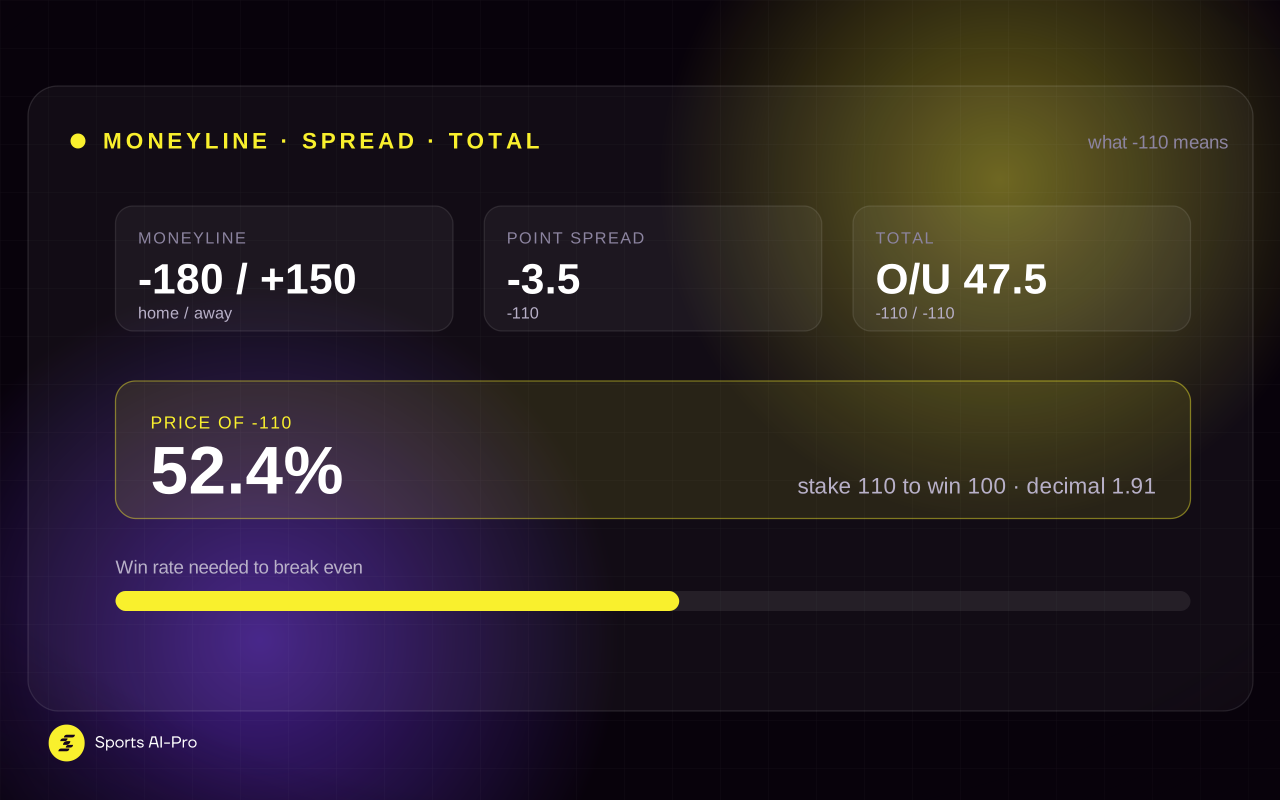
A price of -110 means you stake 110 to win 100, which pays decimal odds of 1.91. It is the standard price on point spreads and totals, where both sides usually carry the same odds.
At -110 the implied probability is 52.4%, so you must win more than that share of your bets to break even. Two sides at -110 add up to 104.8%, and the extra 4.8% is the sportsbook's margin, often called the vig or juice.
Moneyline: pick the winner
A moneyline bet only asks who wins, with no points involved. The favourite has a minus price such as -180, so you stake more to win less, and the underdog has a plus price such as +150. Overtime counts in both the NFL and the NBA.
Point spread: pick the margin
The spread gives the underdog a head start. If the home team is -3.5, it must win by four or more points for a bet on it to win, and a bet on the away team at +3.5 wins if it loses by three or fewer, or wins outright. A whole-number spread such as -3 can end in a push, where the stake is returned.
Totals: over or under
A total is a line for the combined score of both teams, such as 47.5 points in an NFL game or 228.5 in an NBA game. You bet whether the real total finishes over or under it. Overtime points count towards the total.
One game, three lines
Here is how a single game can look on a sportsbook, with made-up numbers. The three lines describe the same game from different angles.
| Market | Home team | Away team |
|---|---|---|
| Moneyline | -180 | +150 |
| Point spread | -3.5 (-110) | +3.5 (-110) |
| Total 47.5 | Over -110 | Under -110 |
Moneyline or spread: which to choose
Moneyline is simpler, and its price shows how likely the sportsbook thinks a win is. The spread removes the question of who wins and asks by how much, which suits games where the favourite is clear but the margin is uncertain. Neither is better in general: judge each price against your own estimate.
Turning a line into a decision
Convert the odds into implied probability, remove the margin and compare the result with your own estimate. The table uses the moneyline from the example above and a made-up estimate of 66% for the home team.
| Step | Result |
|---|---|
| Moneyline (home / away) | -180 / +150 |
| Implied probabilities and their total | 64.3% + 40.0% = 104.3% |
| Home win probability without the margin | 61.6% |
| Your estimate for the home team | 66% |
| Gap in percentage points | +4.4 |
A positive gap suggests the price may be worth taking, and a negative gap means you should pass. This is an illustration, not a real game or a promise of profit: even a real edge loses often.
Common mistakes with American odds
- Reading -110 as a 110 percent chance instead of a stake of 110 to win 100
- Judging a bet on odds alone without converting them to probability
- Ignoring that both sides of a spread carry the sportsbook's margin
- Betting the spread and the moneyline of the same team without a reason
Data-driven sports predictions
AI-assisted match analysis - team stats, H2H, a bet builder and predictions generated by artificial intelligence.
Bet responsibly. Predictions are analytical estimates, not certainties.
-110 is a price, not a verdict
It means staking 110 to win 100 and needs a 52.4% win rate to break even.
Convert before you compare
Turn American odds into probability and remove the margin first.
Three markets, one game
Moneyline picks the winner, the spread picks the margin and the total picks the combined score.
An edge is not a guarantee
Even a good price loses often, so keep stakes small.
What does -110 mean in betting?
It means you stake 110 to win 100. The decimal odds are 1.91 and the implied probability is 52.4%, so you need to win more than that share of your bets to break even.
What does +150 mean in betting?
It means a stake of 100 wins 150 in profit if the bet wins. The decimal odds are 2.50 and the implied probability is 40.0%.
What is the difference between moneyline and point spread?
A moneyline bet only needs your team to win. A point spread bet needs your team to win by more than, or lose by less than, the stated margin.
What does a half point do in a spread?
A half point such as -3.5 removes the push, because no game can finish exactly on the line. Whole numbers such as -3 can end in a push, where your stake is returned.
What is a push in betting?
A push is a bet that lands exactly on the line, for example a 3 point win on a -3 spread. The stake is returned and nothing is won or lost.
Bet smarter with Sports AI-Pro
Team stats, H2H and the analysis panel are free. Unlock AI predictions with a subscription.