Surebet and Arbitrage Betting: How Sure Bets Work and Their Risks
What is arbitrage betting and how do sure bets work? The formula, stake split, a worked example, why surebets appear, hedging bets and the risks.
· 8 min readA surebet (arbitrage bet, or “arb”) sounds too good to be true: you back every possible outcome of an event at different bookmakers and lock in a profit whatever the result. It is real maths, not a trick - but it works only in narrow circumstances and comes with practical risks that most guides skip.
This guide explains how arbitrage betting works, how to calculate the stakes, why sure bets appear at all, how hedging bets differs from arbitrage, and why for most players the risks outweigh the small margins.
What a surebet is
A surebet exists when the best odds on each outcome, taken from different bookmakers, imply a total probability below 100%. Bookmakers build in a margin, so at a single bookmaker the implied probabilities always add up to more than 100%. Combine the best prices from two or more of them and, occasionally, the sum drops under 100% - that gap is your guaranteed profit.
The test is simple: add up 1 ÷ odds for every outcome. Below 100% means an arbitrage opportunity; 100% or more means none. The lower the sum, the larger the profit - but also the more likely that a price is a mistake that will soon be corrected.
How to calculate a surebet and split the stakes
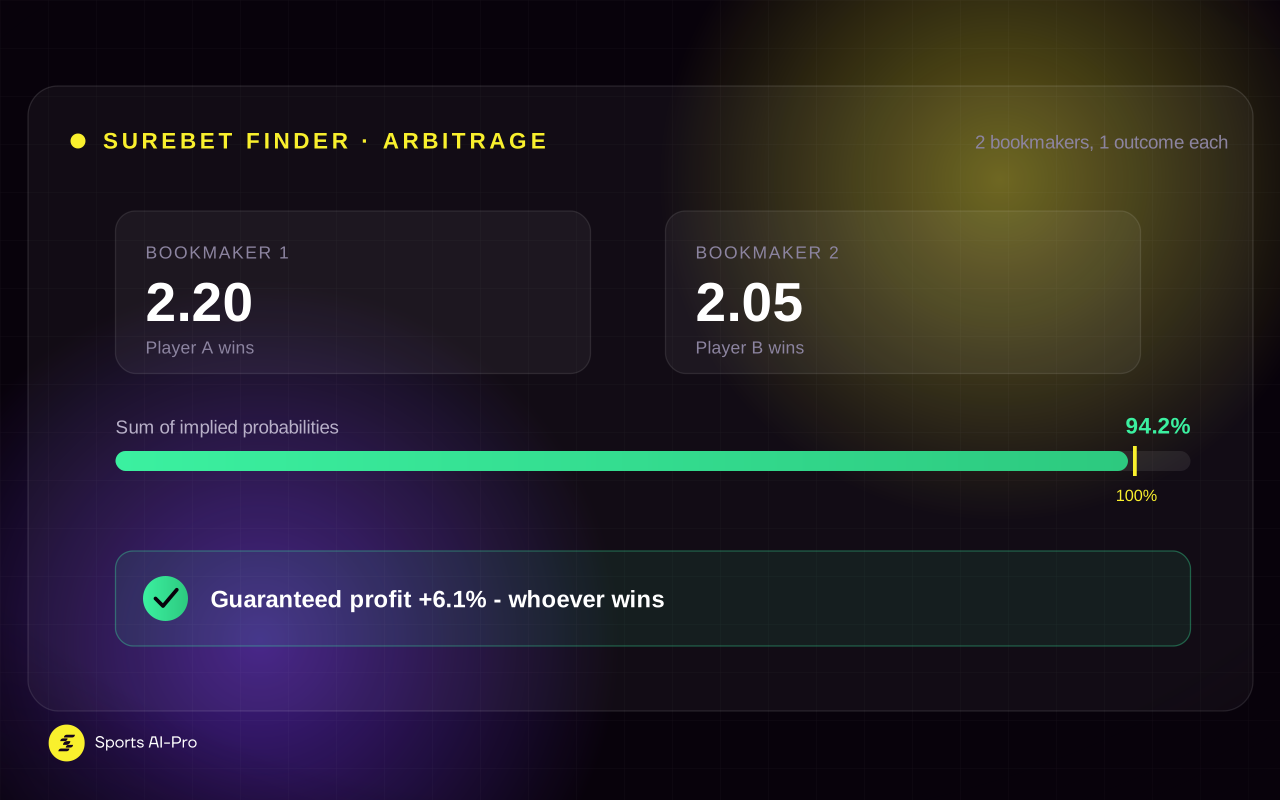
Take a tennis match with two outcomes. Bookmaker 1 offers 2.20 on player A, bookmaker 2 offers 2.05 on player B. The implied probabilities are 45.5% and 48.8%, so the total is 94.2% - under 100%. To get the same payout either way, stake each side in proportion to its implied probability.
With a total stake of 100, put 48.2 on A and 51.8 on B. Whoever wins, you collect about 106.1 - a profit of 6.1 that does not depend on the result. Online arbitrage calculators do this split for you, including for three-way markets such as football 1X2.
| Outcome | Bookmaker | Odds | Stake | Return |
|---|---|---|---|---|
| Player A wins | Bookmaker 1 | 2.20 | 48.2 | 106.1 |
| Player B wins | Bookmaker 2 | 2.05 | 51.8 | 106.1 |
| Total | - | - | 100 | 106.1 |
Why surebets appear
Bookmakers price events independently and update at different speeds, so short-lived gaps open between them. Most of those gaps close within minutes, which is why arbitrage is a race rather than a strategy you can plan around.
| Cause | What happens |
|---|---|
| Different models | Each bookmaker prices the event with its own model and margin. |
| Slow updates | One operator reacts to news or a line move later than the others. |
| Regional pricing | Local bookmakers shade odds towards their home market or favourite team. |
| Promotions and boosts | Enhanced odds can push a price above the market for a short time. |
| Pricing errors | Typos and stale lines - the most profitable, and the most often voided. |
The last row deserves caution. Some “sure bets” come from errors, and bookmakers are entitled to void bets placed at obviously wrong odds, leaving you with only one leg of the pair.
Why the bookmaker margin matters
At one bookmaker the margin pushes the implied total above 100% - typically 104-107%. Arbitrage works only because you pick the best price on each outcome from different places. The chart compares the usual single-bookmaker total with the combined best-odds total (illustrative figures).
Football 1X2 is harder: three outcomes mean three bookmakers and three legs, so the chance that one price moves before you place it is much higher. That is why most surebets are found on two-way markets such as tennis, basketball and over/under.
Data-driven football predictions
AI-assisted match analysis - team stats, H2H, a bet builder and predictions generated by artificial intelligence.
Bet responsibly. Predictions are analytical estimates, not certainties.
How to place a surebet in practice
Doing this by hand is slow, so most people use a scanner and a calculator. The routine is always the same:
- Find a market where the sum of 1 ÷ odds is below 100% and re-check the prices.
- Calculate the stakes so that every outcome pays the same.
- Place the leg most likely to move first, then the second straight away.
- Keep funded accounts at several bookmakers so you can act in seconds.
- Log every pair, including partial fills and voided legs.
Keep stakes modest. A 2-6% profit per pair is small, so the real edge comes from volume and speed - and a single failed leg can wipe out a dozen successful pairs.
The risks of arbitrage betting
The biggest risk is leg risk: you place the first bet, the price on the second disappears, and you are left with a plain one-sided bet. Others include different rules for the same event (retirement in tennis, extra time, void conditions), deposit and withdrawal costs, and being stake-limited.
Bookmakers watch for accounts that only ever take the best price, and they may restrict stakes or close accounts, which their terms allow. Surebet profits are also small relative to the time and money they tie up.
Hedging bets vs arbitrage
Hedging is different: you already hold a bet and place an opposite one to lock in a profit or cut a loss. Example: you backed a team at 4.00 before the season and it reaches the final; backing the opponent now guarantees a result either way. Unlike arbitrage, hedging starts from an existing position, so it is a risk-management tool rather than a source of free profit.
A surebet is a price gap
If the sum of 1 ÷ odds across the best prices is below 100%, a profit is locked in.
Speed beats skill
Opportunities last minutes and are mostly found on two-way markets.
Leg risk is the real danger
A price that moves between the two bets turns arbitrage into an ordinary wager.
Limits are likely
Bookmakers can restrict accounts that only take the best price.
Is surebet betting legal?
Yes. Arbitrage betting is legal in most countries and is not cheating, because you place real bets at published odds. Bookmakers may, however, limit stakes or close accounts under their terms.
How much can you earn on surebets?
Usually 1-5% of the stake per pair, occasionally more. Profit scales with volume and speed and is reduced by failed legs, fees and limits, so it is not a reliable income.
Why do bookmakers limit surebet accounts?
Because accounts that only take the best price cost them money. Mixing in ordinary bets and spreading across operators lowers the risk but does not remove it.
Bet smarter with Sports AI-Pro
Team stats, H2H and the analysis panel are free. Unlock AI predictions with a subscription.